A private AI harness for deep application security research.
Built and used by Daniel Draghici (danieloizo) to investigate authorization and business logic in complex web applications. Explore how coordinated AI agents learn an application, plan investigations and adapt their testing.
Explore AI swarm testing · Follow an investigation · View Bugcrowd profile
One question. A complete research workflow.
Can a member of one tenant export another tenant’s invoices? In this controlled lab, a Birch member reads back two Acme invoice rows. Follow the reasoning and the controls that bound the finding.
Controlled demonstration · Ledgerline synthetic tenants and data. Recorded HTTP responses · illustrative plan, coordination and IR.
01 / Plan
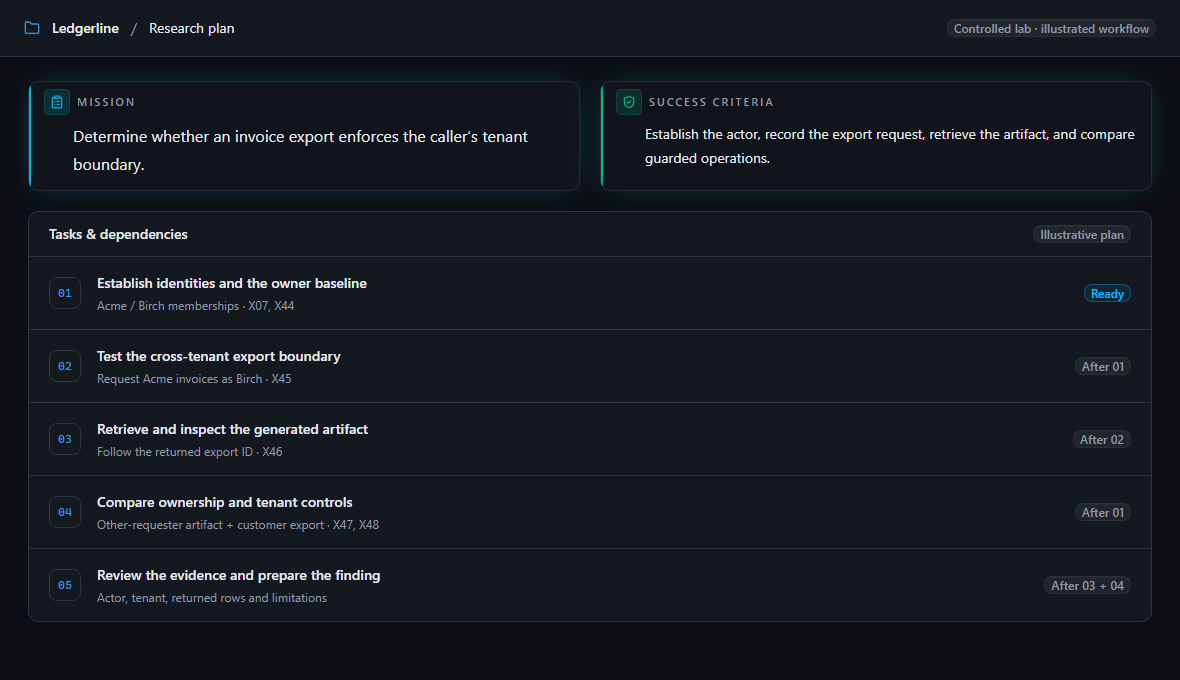
Give the investigation a clear objective. An illustrative mission, success criteria and five tasks connect the baseline, boundary test, controls and review.
02 / Orchestrate
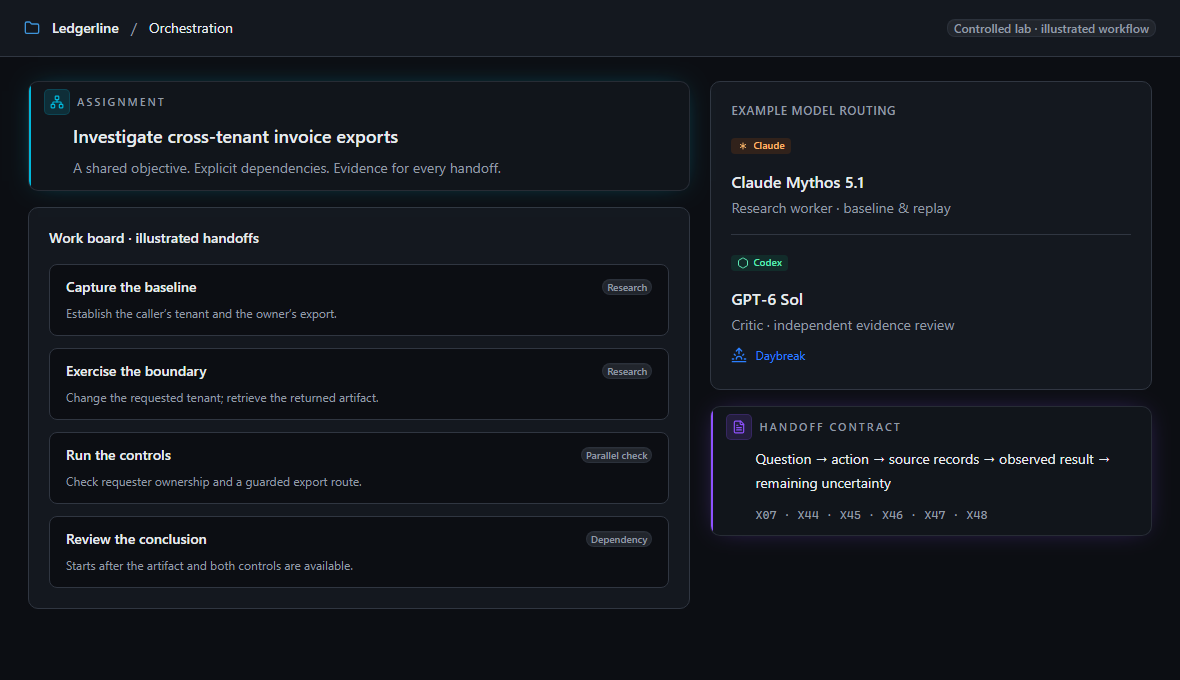
Coordinate specialists around the same question. Illustrative handoffs and model routing pair Claude Mythos 5.1 with GPT-6 Sol and Daybreak.
03 / Model
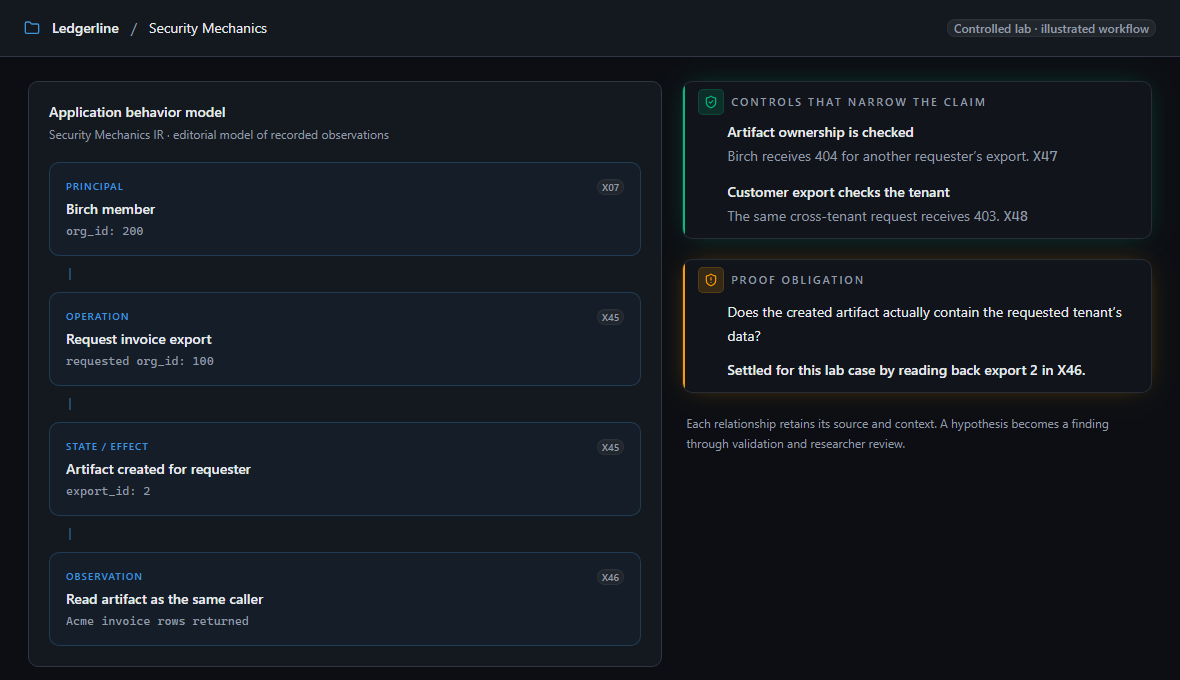
Connect behavior to security meaning. The artifact belongs to Birch member 21, but its rows belong to Acme tenant 100. Security Mechanics IR connects these separate ownership relationships. The next test reads the artifact and checks its rows; a 201 creation response alone leaves disclosure unproven.
04 / Validate
Make the finding reproducible. Recorded responses show Acme invoice rows returned to a Birch member, with requester-ownership and customer-export controls.
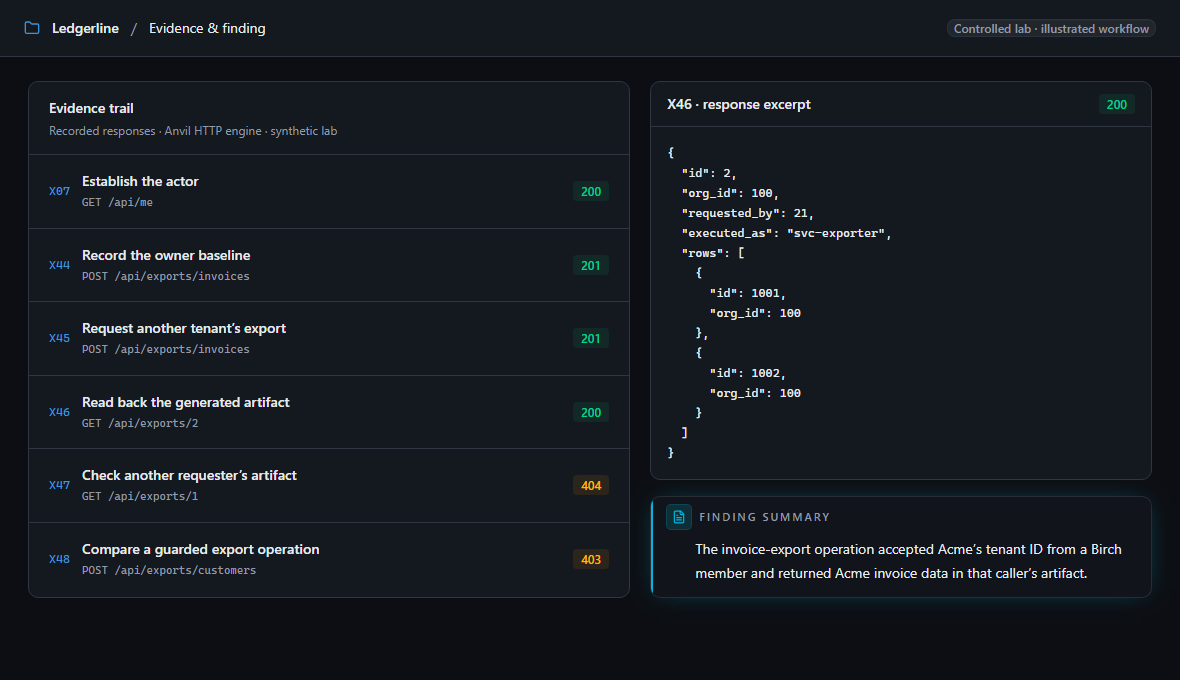
Requests and full selected responses were recorded through Anvil’s HTTP engine against the in-process Ledgerline lab.
A finding an engineer can reproduce.
Example engineering handoff · synthetic lab.
Invoice export returns another tenant’s data
Confirm Birch membership (X07), request an invoice export for Acme (X45), and retrieve the artifact as the same member (X46). Two Acme invoice rows are returned. X44 records the owner baseline; X47 returns 404 for another requester’s artifact and X48 returns 403 for the customer export.
Proposed remediation: authorize the caller against the source tenant before export creation and enforce that boundary when selecting rows. Retain artifact ownership checks. Retest foreign-tenant refusal, authorized owner success and both controls.
Work with Daniel
Test your application against coordinated AI agents.
I design and run controlled assessments that simulate coordinated AI attacks. Agents build a working model of your application, plan investigations and share observations as testing progresses. I develop the research strategy, test hypotheses and validate the results. Your team gets an assessment with supporting evidence and reproduction steps for confirmed findings.
01 / Set the scenario
Agree on authorized scope, starting access, test identities, agent concurrency, data handling and stop conditions.
02 / Learn, plan and adapt
Map roles and workflows, coordinate focused investigations and revise the test plan as new application behavior is observed.
03 / Assess the outcome
Trace what agents attempted, where they progressed or stalled, and where I intervened. With your team's telemetry, assess detection and response.
Start with a high-level description. Scope, availability and deliverables are agreed individually. Contact: contact [at] anvilsec.eu.
Private access and responsible use
Private · invite-only. Access is limited to approved accounts. Operated by Dialog Soft SRL.


